TECHERICS
How to Calculate Sales Tax (With Examples)
Sales tax = price × rate. Learn the formula, work out 8.5% tax on $80 and other examples, reverse tax out of a total, and find the rate from a receipt.
Contents
- The short answer
- What is the sales tax formula?
- How do I calculate sales tax on a price?
- Worked example: 8.5% sales tax on $80
- More worked examples
- How do I remove sales tax from a total?
- How do I find the sales tax rate from a receipt?
- How much sales tax will I pay? It depends on where you are
- What are the common mistakes when calculating sales tax?
- How do I calculate sales tax in a spreadsheet?
- The short version, once more
The short answer
To calculate sales tax, multiply the price by the tax rate as a decimal, then add the tax to the price. The formulas are: Tax = price × (rate ÷ 100), and Total = price + tax. For example, 8.5% sales tax on $80 is 80 × 0.085 = $6.80, so you pay $86.80 in total. The whole calculation is one multiplication and one addition, and it works for any price and any rate.
The short version: sales tax is a percentage added to the price of goods and some services at the till. The rate you pay is usually a state rate plus county and city rates combined, so it changes by location — there is no single US sales tax rate. Always calculate tax on the price before tax, round the result to the nearest cent, and remember that five states charge no statewide sales tax at all. This is general information, not tax advice — tax rules change, so confirm the rate with your state or local tax agency before relying on a figure for business or filing.
Try it now: Online Calculator — do the percentage math in your browser, free, no signup. For a full walkthrough of the tool, see the online calculator guide.
What is the sales tax formula?
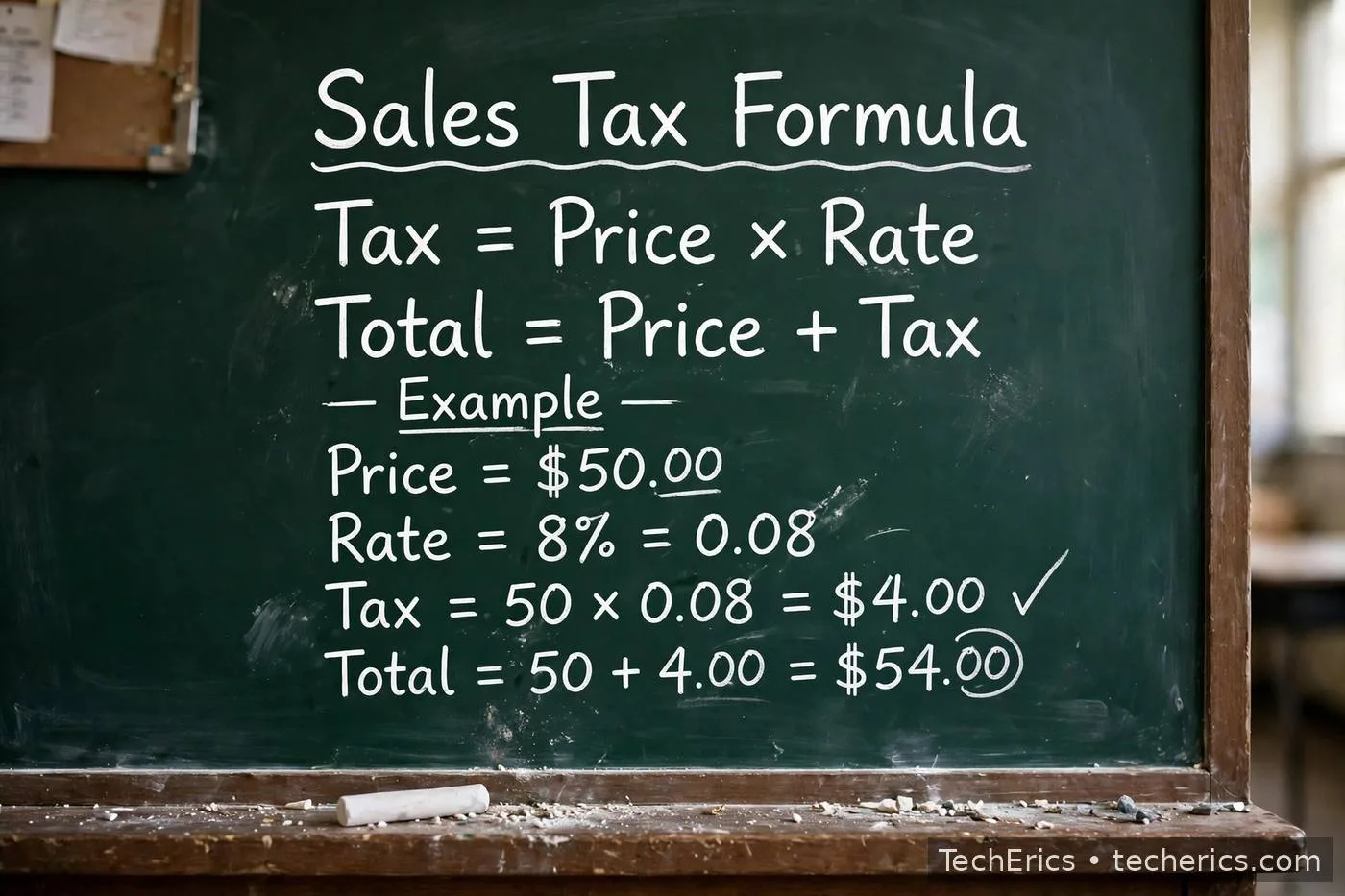
Sales tax is one idea: a percent means “per hundred”, so 8.5% is the same as 0.085, and every result below comes from that. There are four formulas, and they cover every sales tax question you will meet — adding tax, removing tax, and finding the rate.
| What you want | Formula | When to use it |
|---|---|---|
| Tax amount | Tax = price × (rate ÷ 100) | You know the price and the rate |
| Total with tax | Total = price + tax, or price × (1 + rate ÷ 100) | You want the amount at the till |
| Price before tax | Price = total ÷ (1 + rate ÷ 100) | The total includes tax and you want the original price |
| The rate | Rate = (total − price) ÷ price × 100 | You know the price and the total and want the rate |
The one-step total formula is the fastest for everyday use: multiply the price by 1 plus the rate as a decimal. At 8.5%, that is price × 1.085. At 6.25%, it is price × 1.0625. One multiplication, and you have the amount you will actually pay.
How do I calculate sales tax on a price?
Three steps, and the same three steps every time: convert the rate to a decimal, multiply by the price, add the tax to the price. Round the tax to the nearest cent at the end — never in the middle, or the cents drift.
- Convert the rate to a decimal. Divide the percentage by 100. 8.5% becomes 0.085, 6.25% becomes 0.0625, 7% becomes 0.07.
- Multiply by the price. Tax = price × decimal rate. This is the tax amount.
- Add the tax to the price. Total = price + tax. That is the amount at the till.
Worked example: 8.5% sales tax on $80
This is one of the most-searched sales tax questions, and the arithmetic is short:
- Rate as a decimal: 8.5 ÷ 100 = 0.085
- Tax: $80 × 0.085 = $6.80
- Total: $80 + $6.80 = $86.80
So an $80 item at 8.5% sales tax costs $86.80 at the till, and $6.80 of that is tax. Check the maths instantly with the Online Calculator.
More worked examples
| Question | Calculation | Answer |
|---|---|---|
| 8.5% tax on $1,200 | 1,200 × 0.085 = 102 | Tax $102.00, total $1,302.00 |
| 8.5% tax on $49.99 | 49.99 × 0.085 = 4.24915 → $4.25 | Tax $4.25, total $54.24 |
| 6.25% tax on $36.50 | 36.50 × 0.0625 = 2.28125 → $2.28 | Tax $2.28, total $38.78 |
| 7% tax on a $64 pair of headphones | 64 × 0.07 = 4.48 | Tax $4.48, total $68.48 |
| 8.5% tax on $100 | 100 × 0.085 = 8.50 | Tax $8.50, total $108.50 |
Notice the $49.99 example: the raw multiplication gives $4.24915, which rounds to $4.25. Sales tax is always rounded to the nearest cent, and the rounding happens once, at the end. If you round the rate or the intermediate result early, the final cents come out wrong.
How do I remove sales tax from a total?
Sometimes you only know what you paid, and you need the price before tax — for a refund, an expense claim, or checking a receipt. The mistake most people make is subtracting the rate from the total: taking 8.5% off $54.24 gives $49.63, which is wrong. The tax was charged on the pre-tax price, not on the total, so you have to divide, not subtract.
The formula is: Price before tax = total ÷ (1 + rate ÷ 100). Then Tax = total − price before tax.
- You paid $54.25 total and the rate is 8.5%: $54.25 ÷ 1.085 = $50.00. The item cost $50 before tax, and the tax was $4.25.
- You paid $107.10 total and the rate is 5%: $107.10 ÷ 1.05 = $102.00. The price was $102.00 and the tax was $5.10.
- You paid $108.50 total and the rate is 8.5%: $108.50 ÷ 1.085 = $100.00. The price was $100.00 and the tax was $8.50.
If the division gives a long decimal, round to the nearest cent. A result of $49.995 becomes $50.00 — that is normal, and it is why receipts sometimes differ from your hand calculation by a cent.
How do I find the sales tax rate from a receipt?
If a receipt shows the price and the total but not the rate, the rate is the tax divided by the pre-tax price, times 100. Rate = (total − price) ÷ price × 100.
- A $25 item rang up as $26.75. The tax was $1.75. 1.75 ÷ 25 × 100 = 7%.
- A $50 item rang up as $54.25. The tax was $4.25. 4.25 ÷ 50 × 100 = 8.5%.
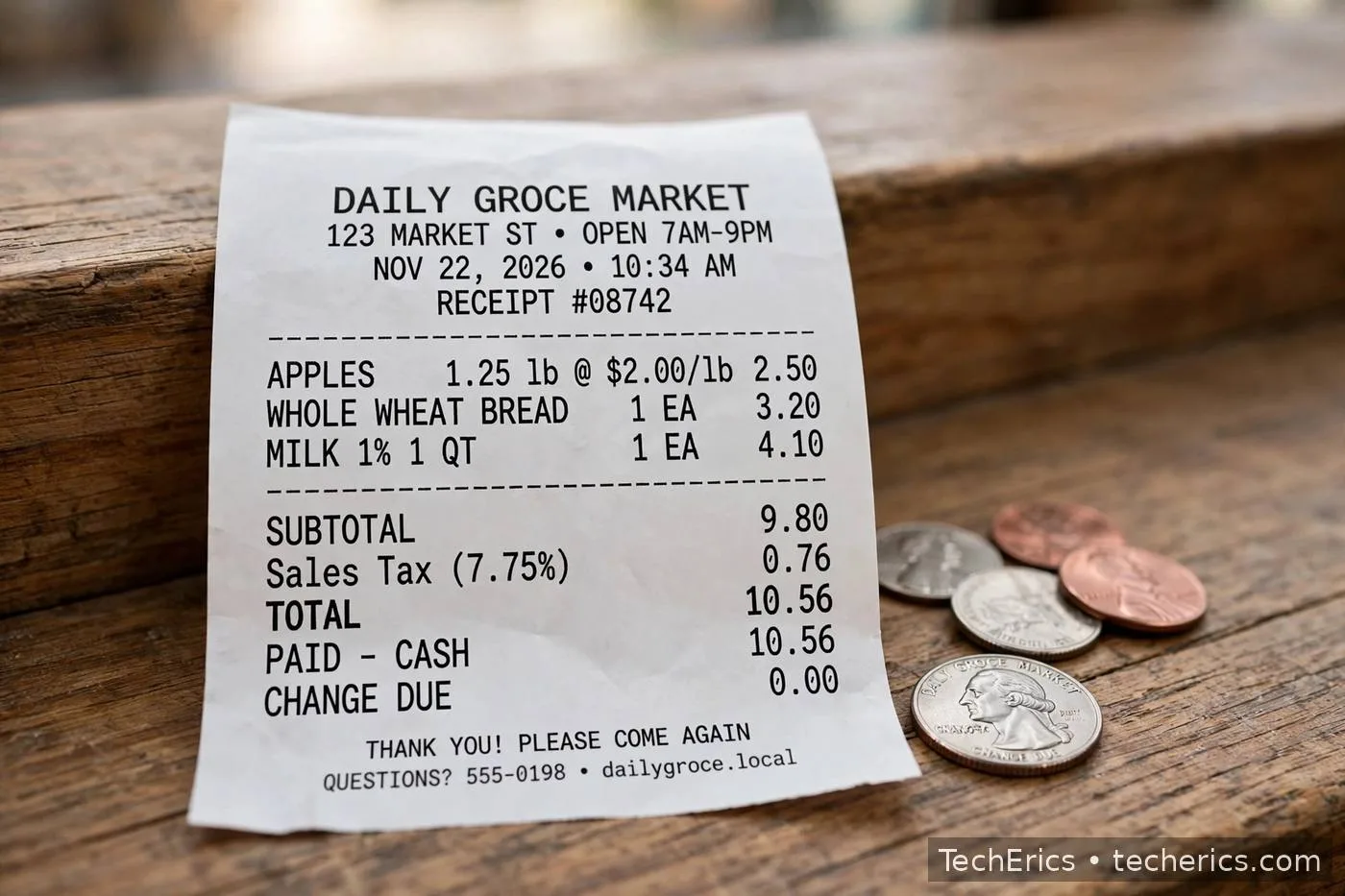
- A $36 lamp rang up as $38.79. The tax was $2.79. 2.79 ÷ 36 × 100 = 7.75%.
This is also how you check whether a shop charged you the right rate: take the receipt’s pre-tax price and total, work out the rate, and compare it with the combined rate your state and city publish. If the numbers do not match, the difference is usually a local district rate you did not know about — or a mistake worth asking about.
How much sales tax will I pay? It depends on where you are
There is no single US sales tax rate. The rate you pay is usually a combination of a statewide rate and local rates for the county, city and any special districts, and it can change between two shops on opposite sides of a street. As of 2026, 45 states and Washington, D.C. levy a statewide sales tax, and five states charge no statewide sales tax at all:
| No statewide sales tax | Note |
|---|---|
| Alaska | No state rate, but some local areas charge their own tax |
| Delaware | No sales tax |
| Montana | No sales tax |
| New Hampshire | No sales tax |
| Oregon | No sales tax |
Among the states that do charge, combined state-and-local rates vary widely. According to mid-2026 data, the highest average combined rates are in Louisiana (about 10.13%), Tennessee (about 9.61%), Washington (about 9.57%), Arkansas (about 9.48%) and Alabama (about 9.46%). Rates change often and depend on the exact address of the sale, so a state average is a guide, not the rate on your receipt — use the rate on a recent local receipt, or your state tax agency’s lookup, for the exact figure.
The rate also depends on what you are buying. Most states tax goods and some services, but many exempt groceries, prescription medicine, or clothing, and the exemptions differ by state. A $100 grocery bill and a $100 electronics bill in the same shop can carry different tax — which is why the formula always starts with “find the rate for this purchase”, not “find the rate for this state”.
What are the common mistakes when calculating sales tax?
Four mistakes cause almost every wrong answer, and all four are easy to avoid once you know them.
- Calculating tax on the total instead of the price. Tax is charged on the pre-tax price. 8.5% of a $54.24 total is $4.61, but the real tax on that purchase was $4.25 — the $54.24 already includes tax. Always multiply the pre-tax price.
- Subtracting the rate to remove tax. Taking 8.5% off a $54.25 total gives $49.64, not the $50.00 pre-tax price. To remove tax, divide by (1 + rate), as shown above.
- Rounding too early. Rounding the rate to 8% instead of 8.5%, or rounding the tax before adding it, shifts the total by cents or dollars. Keep full precision until the last step, then round once to the nearest cent.
- Using the wrong rate. A state rate is not the combined rate. If your state charges 6% and your city adds 2.5%, the rate on your receipt is 8.5%, not 6%. Always use the combined rate — the one printed on a recent local receipt.
How do I calculate sales tax in a spreadsheet?
If you work out sales tax often, a spreadsheet does it in one setup. Put the price in one cell and the rate in another, then use the formulas — the same ones from the table at the top, written as cell formulas.
| Cell | What to type | Example |
|---|---|---|
| B1 | Original price | 100 |
| B2 | Tax rate (%) | 8.5 |
| C1 | Tax amount: =(B1*B2)/100 | 8.50 |
| C2 | Total price: =B1+C1 | 108.50 |
| D1 | Price before tax from a total: =D1/(1+(B2/100)) | (put the total in D1 first) |
Change B1 or B2 and every result updates. That is the whole setup — no add-ons, no macros, and it works the same in Excel and Google Sheets.
The short version, once more
Sales tax = price × (rate ÷ 100). Total = price + tax. To remove tax from a total, divide by (1 + rate ÷ 100). To find the rate from a receipt, divide the tax by the pre-tax price and multiply by 100. Round once, at the end, to the nearest cent. The rate is local — state plus county plus city — so use the rate on a recent local receipt, and remember that Alaska, Delaware, Montana, New Hampshire and Oregon charge no statewide sales tax. This is general information, not tax advice.
Work it out in seconds — Online Calculator. Free, in-browser, no signup. General information only — tax rules change, so confirm the rate with your state or local tax agency before relying on a figure for business or filing.
Frequently asked questions
How do I calculate sales tax on a price?
Multiply the price by the tax rate as a decimal, then add the tax to the price. Tax = price × (rate ÷ 100); Total = price + tax. At 8.5%, an $80 item costs $80 × 0.085 = $6.80 in tax, $86.80 in total.
How much is 8.5% sales tax on $80?
$6.80 in tax, for a total of $86.80. The calculation is 80 × 0.085 = 6.80, then 80 + 6.80 = 86.80.
How do I calculate sales tax in my head?
Convert the rate to a decimal and multiply. For 8% on $50: 50 × 0.08 = $4.00, total $54.00. For a quick estimate, work out 10% of the price (move the decimal one place left) and adjust: 8% is a little less than 10%, 6% is a little more than half of 10%.
How do I remove sales tax from a total?
Divide the total by (1 + rate ÷ 100). A $54.25 total at 8.5% is $54.25 ÷ 1.085 = $50.00 before tax, so the tax was $4.25. Do not subtract 8.5% of the total — that gives the wrong answer, because the tax was charged on the pre-tax price.
Which states have no sales tax?
Five states charge no statewide sales tax: Alaska, Delaware, Montana, New Hampshire and Oregon. Alaska has no state rate but some local areas charge their own tax. Every other state plus Washington, D.C. levies a statewide sales tax.
What is the sales tax on $100?
It depends on the rate. At 8% it is $8.00 (total $108.00); at 8.5% it is $8.50 (total $108.50); at 6.25% it is $6.25 (total $106.25). Multiply $100 by the rate as a decimal — the tax on $100 is always the rate itself, in dollars.
How do I find the sales tax rate from a receipt?
Subtract the pre-tax price from the total to get the tax, divide by the pre-tax price, and multiply by 100. A $25 item that rang up as $26.75 carried $1.75 of tax: 1.75 ÷ 25 × 100 = 7%.
Is sales tax the same as VAT?
No. Sales tax is charged once, at the final sale to the customer, and it is added on top of the displayed price. VAT (value-added tax) is charged at each stage of production and is usually included in the displayed price. The US uses sales tax; most other countries use VAT. The arithmetic is similar — a percentage of a price — but the rate, the rules and where the tax appears are different.